


































For the first time, humans see the "dance steps" of black holes clearly

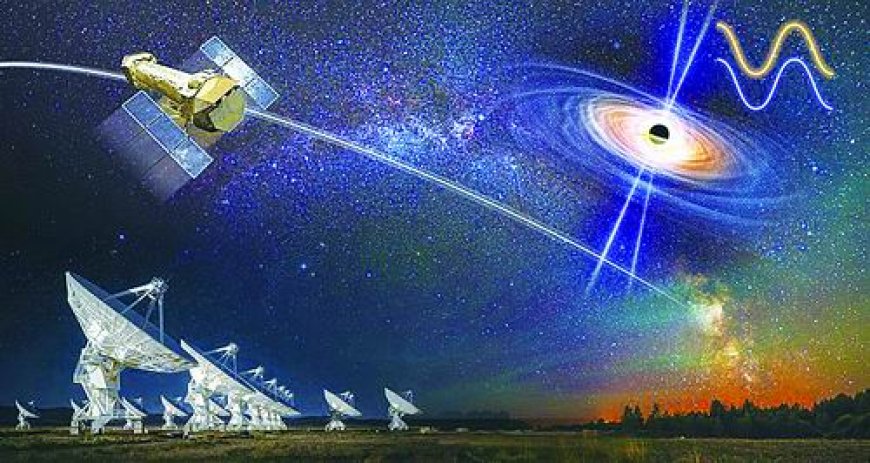
At noon on December 12, in the conference room of the National Astronomical Observatory of the Chinese Academy of Sciences in Beijing, researchers Liu Jifeng and Wang Yanan, associate professors of the University of Chinese Academy of Sciences Huang Xiang, and Huazhong University of Science and Technology professor Lei Weihua were focusing on a "cosmic storm" 120 million light-years away - a star was torn apart by a supermassive black hole, and the debris formed a hot accretion disk and drove the jet to oscillate synchronously. Just a day ago, the research results led by them and published in Science Advances in conjunction with more than 30 domestic and foreign institutions obtained strong observational evidence for the first time in the tidal collapse event (TDE) AT2020afhd, and "seen" the "dance step" of the black hole system - the coordinated precession of the accretion disk and the jet.
AT2020afhd is located at the center of the galaxy LEDA 145386, about 120 million light-years from Earth. A tidal collapse event is a violent astronomical phenomenon in which a supermassive black hole is torn apart by its powerful tidal forces when a star is too close to the center of a galaxy. Some star fragments form a high-temperature accretion disk during the fall, releasing intense radiation. The team believes that the synchronous precession of the accretion disk and the jet is likely to stem from the "Lance-Tilling effect" predicted by general relativity, that is, the rotating black hole drags the surrounding space-time, causing the tilted accretion disk and its vertical jet to swing periodically as a whole. Although theories have long predicted the "dancing" form of black hole systems, it is challenging to obtain clear observational evidence.
In January 2024, Wang Yanan noticed AT2020afhd through the "Temporary Source Name Service Network". "After discovering the presence of X-ray radiation in this event, we immediately triggered a higher frequency of X-ray monitoring." "But I didn't expect this source to be so special at the time. Until after monitoring for a month, it was found that there were drastic changes in its X-ray radiation. The team decided to start intensive monitoring, so they quickly organized international collaborative observations and carried out multi-band high-frequency observations for more than a year.
The turning point occurred 215 days after the discovery of the event: the quasi-periodic oscillation with an X-ray light change presentation period of about 19.6 days and an amplitude of more than 10 times; The radio band synchronously changes more than 4 times the amplitude. "This cross-band, high-amplitude, quasi-periodic synchronization behavior shows that there is a rigid connection between the accretion disk and the jet, which precesses together around the black hole's axis of rotation like a gyroscope." Wang Yanan said. The cooperative precession model constructed by the team successfully reproduced the observation data and set clear limits on parameters such as system geometry, black hole spin and jet velocity.
At present, under the leadership of the National Astronomical Observatory of China, a research group on tidal collapse events has been established in China to regularly carry out academic exchanges to provide intellectual support for major discoveries. Looking forward to the future, Liu Jifeng said: "With the operation of a new generation of time-domain astronomical facilities such as the 'Sitian Project' (GOTTA) and the 'Tianguan' satellite, we will achieve full-sky depth, multi-band, and high-frequency monitoring, discover more such events, and deepen our understanding of black hole accretion physics." ”
What's Your Reaction?
 Like
0
Like
0
 Dislike
0
Dislike
0
 Love
0
Love
0
 Funny
0
Funny
0
 Angry
0
Angry
0
 Sad
0
Sad
0
 Wow
0
Wow
0