


































Biological computing moves forward in controversy

Biocomputing refers to a new computing model developed by using the inherent information processing mechanism of biological systems. Scientists are trying to train human neurons and build them into systems with "biological transistors" capabilities.
The British "Nature" website pointed out in a recent report that some scientists believe that biological computing systems are expected to become a low-energy alternative to traditional computers, with the potential to rival artificial intelligence and quantum computers. However, not everyone is optimistic about it. Madeleine Lancaster, a developmental biologist at the University of Cambridge in the United Kingdom, and others believe that the current research is suspected of being hyped, and the result may be counterproductive. If these systems are given perception and consciousness as a consensus, it could have far-reaching implications for the scientific community.
Biocomputing is attracting attention
To mimic the efficient structure of the brain, some scientists have tried to use silicon chips to simulate the connection and firing mechanisms of neurons, a field known as neuromorphic computing. Other scientists have taken a different approach, directly using biological neurons to develop highly powerful biological computing devices with very low energy consumption.
The technological path of biocomputing is very different from that of silicon chips. Scientists have used induced pluripotent stem cells to grow three-dimensional brain-like organs that contain both neurons and other cells that play a supporting role. Interacting with these cells through electrode arrays, electrical signals can alter the flow of ions inside and outside the neuron, even triggering electrical impulses called "action potentials." After the electrodes capture these biological signals, the algorithm converts them into usable information.
In August this year, Benjamin Ward-Cheryl, a roboticist at the University of Bristol in the United Kingdom, and a team used organoids composed of brain neurons of about 10,000 people to "recognize" Braille letters. The experimental results showed that the recognition accuracy of a single organoid to a specific letter was 61%, while when the three organoids worked together, the accuracy increased to 83%. This proves that such biological systems have the basic ability to process information and can complete the task of identifying and recognizing inputs.
In addition, a 2024 study also showed that a system built from mouse neuronal organoids can even play computer games such as "inverted pendulum", which is tasked with maintaining the balance of a swing rod on a mobile trolley.
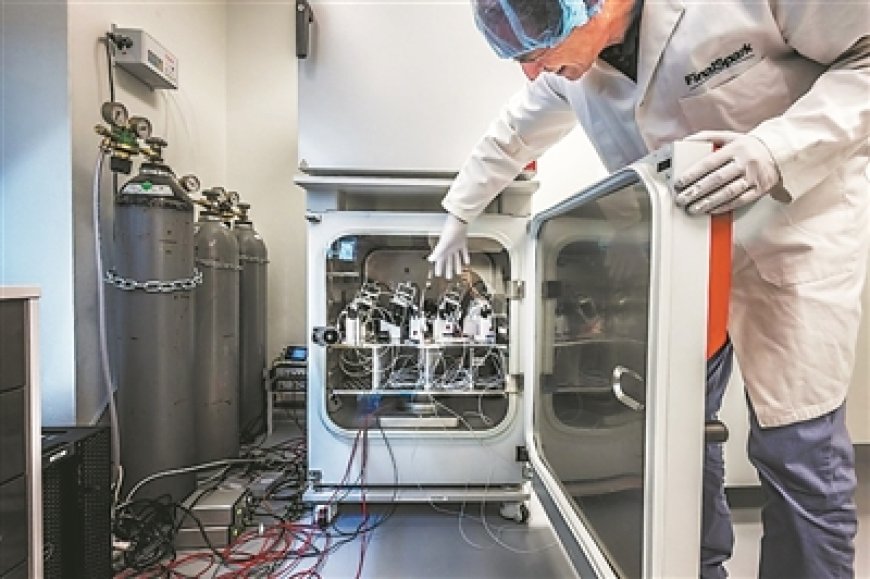
Fred Jordan, co-founder of Swiss brain organ cultivation company FinalSpark, believes that biological neurons are 1 million times more energy efficient than artificial neurons. Biocomputing is expected to alleviate the current soaring energy consumption pressure of AI. Perhaps in the near future, brain cell-based processors will gradually replace the traditional chips that drive this round of AI boom.
The application scenarios are becoming increasingly extensive
At present, many scientific research teams have used the organoids provided by FinalSpark for free. Scientists at the University of Michigan at Ann Arbor are observing the behavioral responses of organoids through different types of stimuli; Researchers at the Free University of Berlin in Germany are working on using machine learning tools to efficiently extract information from neural firing patterns.
Similar to FinalSpark, Australia's Cortical Labs has also opened up online access to its neural cultures and launched the world's first biocomputer, the CL1. The device combines cultured neurons with a programmable interface that allows users to send instructions and analyze electrical responses. The company has delivered a small amount of equipment to laboratories around the world, some of which are dedicated to studying basic mechanisms such as neuroplasticity and network dynamics, and some teams are exploring its application in robotics, and even trying to develop brain cell-based entertainment programs, including games and experimental music products.
The neural organoids cultivated by Alison Motley's team at the University of California, San Diego, each contain about 2.5 million different types of neurons. They are trying to apply organoids to a real-world problem - predicting the spreading path of oil spills that may occur in the Amazon rainforest region.
The prospects are still in question
Despite the promise, Johns Hopkins researcher Lena Smirnova pointed out that current biocomputing is still like a "castle in the air" and is far less accessible than biomedical research. She believes that this situation may usher in a major change in the next two decades.
Jordan also admitted that the current capabilities of these biological computing systems are far from comparable to the silicon-based hardware that supports the global digital infrastructure.
Lancaster questioned the essence of some of the experiments. She does not believe that the results currently being shown can be called true "calculations". A study last year showed that even abiotic hydrogels without neurons can "learn" to play table tennis games. In her view, such systems that only present simple feedback, the so-called "learning" behavior may just be random noise.
Some scientists worry that sci-fi imagery such as "brain in a bottle" may cause ethical controversy and even regulatory restrictions. Lancaster warned that neural organoids are currently mainly used in basic neuroscience research, and excessive hype of biocomputing could lead to a blanket ban on legitimate research aimed at benefiting humanity.
What's Your Reaction?
 Like
0
Like
0
 Dislike
0
Dislike
0
 Love
0
Love
0
 Funny
0
Funny
0
 Angry
0
Angry
0
 Sad
0
Sad
0
 Wow
0
Wow
0