

































Insect-grade micro flying robots are introduced

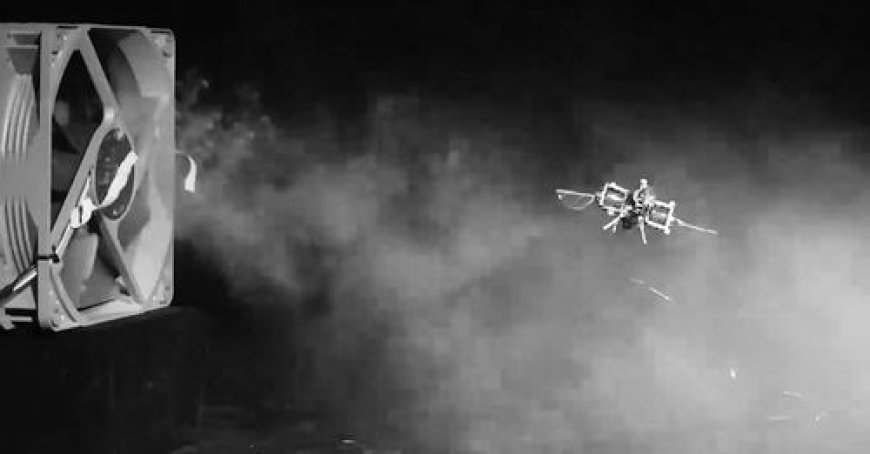
Insects in the air are some of the most agile creatures on Earth, capable of making sharp turns, braking, and mid-air flips with precision. Engineers have long worked to give similar agility to flying robots or drones of the same size. Today, scientists at the Massachusetts Institute of Technology (MIT) in the United States have taken an important step towards this goal. The speed and stunt performance of the miniature winged robots they developed surpassed all previous models, and even approached the agility of real insects. On December 3, the relevant study was published in Science Advances.
Hoang-Vu Phan, an aerospace engineer at the University of Nevada at Reno in the United States, noted that the new device marks a "huge leap in the performance of microrobots." "This achievement brings the field closer to truly autonomous insect-sized flying robots capable of performing real-world tasks."
Although aircraft such as drones have become increasingly sophisticated in recent years, it is extremely difficult to reduce them to the size of insects. "All components had to be designed from scratch." Chen Yufeng, an engineering physicist at MIT and the author of the paper, pointed out. Micromotors are less efficient as they shrink in size, and even slight airflow disturbances can put a strain on flappers and fine joints – components that are often designed to be slim and delicate to reduce weight. Insects can hit glass windows and withstand strong winds unscathed, but miniature flying robots are not as durable because synthetic materials simply cannot match the toughness of real insect bodies.
Chen Yufeng's team has overcome many hardware problems in previous projects and successfully developed a durable aircraft weighing only 750 mg, with a single endurance of up to 1,000 seconds. But its controller, the electronic "brain" that directs the robot's actions, presents a new challenge. To achieve airborne acceleration, steering, and flipping, flying microrobots must continuously adapt to small changes in airflow and friction, requiring an efficient controller that can handle uncertainty.
The author of the paper, MIT astrophysicist and aeronautical engineer Jonathan How, solved this problem by designing a tubular model predictive controller (MPC). How explained that the tubular MPC creates a tubular buffer zone around the robot's central trajectory, ensuring that the robot does not hit dangerous areas due to any interference.
The real "core technology" of the controller, Howe added, lies in the incorporation of a neural network — a computer software or algorithm that mimics the central nervous system of a real fruit fly. This programming allows the controller to quickly plan the optimal path, allowing the robot to rotate in the air "in a way that does not self-destruct."
The final device is only 4 centimeters in diameter, weighs less than a paper clip, flies almost five times faster than existing microrobots, and has twice the acceleration capacity. It can also make sharp turns in gusts of 160 centimeters per second, and most impressively, the robot can perform 10 consecutive flips in 11 seconds. As Phan noted, the robot demonstrated "speed, agility, and robustness previously only observed in real insects."
However, the robot still has some limitations. Pakpong Chirarattananon, a roboticist at the University of Toronto, Canada, said frankly: "The most prominent problem is the constraints of the connecting wiring harness. He explained that since insect-sized batteries run out quickly, the device must be connected to an external power source, which limits the range of motion.
Ropes are a long-term obstacle, and Chen and How also hope to design cameras and other sensors that are small enough to be mounted on robots, which may make it valuable in search and rescue missions. "If there is an earthquake," Chen Yufeng explains, "we can send these tiny robots into the cracks. ”
Insect-sized flying robots are also seen as tools to assist in pollination, but How believes that landing robots on delicate flowers may be too risky. "We would love to do it, but it's beyond the current state of technology," he said. ”
What's Your Reaction?
 Like
0
Like
0
 Dislike
0
Dislike
0
 Love
0
Love
0
 Funny
0
Funny
0
 Angry
0
Angry
0
 Sad
0
Sad
0
 Wow
0
Wow
0