


































Why “Adhere to Domestic Demand Dominance” is Put in the First Place

The Central Economic Work Conference has just concluded, and the economic work blueprint for 2026 has been rolled out. Among the eight key tasks, "adhering to the dominance of domestic demand and building a strong domestic market" is placed first. This not only reflects the decision-makers' profound insight into the current economic situation, but also releases a clear and firm signal: the bright future of the Chinese economy is contained in the growing needs of more than 1.4 billion people for a better life.

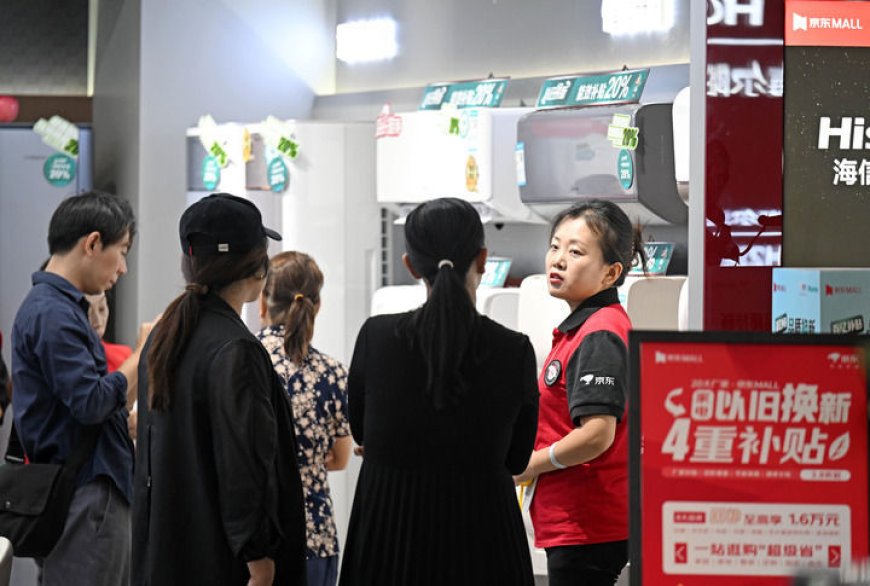
From January to November this year, the trade in of consumer goods has driven sales of related products exceeding 2.5 trillion yuan, benefiting over 360 million people. Xinhua News Agency Information Image
Since the beginning of this year, China's economy has been pushing forward under pressure. In the complex and severe external environment, the main goals of economic and social development will be successfully achieved, and the 14th Five Year Plan is about to come to a successful conclusion. The achievements are hard won, but challenges still exist.
The meeting clearly pointed out that the prominent contradiction between strong domestic supply and weak demand is one of the main problems in the current economic operation. The key to resolving this contradiction lies in stimulating domestic demand potential, especially consumption potential. Consumption is the ultimate demand and the enduring driving force of economic growth. Only by enabling residents across the country to 'be able to consume, dare to consume, and be willing to consume', can the economic cycle truly become smooth.
Multiple efforts will be made to further ignite residents' enthusiasm for consumption
The meeting proposed to "deeply implement the special action to boost consumption" and "formulate and implement plans to increase the income of urban and rural residents", which grasped the fundamental goal of expanding domestic demand. Income is the foundation of consumption, without stable income growth, consumption lacks support.
Therefore, taking "increasing income" as a prerequisite for boosting consumption reflects the systematic and forward-looking nature of policy design. The meeting emphasized the need to focus on stabilizing employment, enterprises, markets, and expectations, in order to solidify the foundation of residents' income growth. Only when the enterprise is stable, can the position be stable; Only when the position is stable can the income be stable; Only when income is stable can consumer confidence truly recover.
It is worth noting that the meeting emphasized the need to "unleash the potential of service consumption" and proposed "cleaning up unreasonable restrictions in the consumption sector". This proposition has strong practical relevance.
In 2024, the per capita service consumption expenditure of Chinese residents will account for 46.1% of the per capita consumption expenditure, which is still significantly lower than that of developed countries. Whether it is cultural tourism and leisure, education and training, medical care and rehabilitation, or information and communication, there is a strong demand for service consumption, but some institutional barriers still constrain the quality and efficiency of supply. The clear proposal to clean up unreasonable restrictions in the consumer sector means that more high-quality, convenient, and diverse services will emerge at an accelerated pace, and people's consumption choices in these areas will be more diverse, and their experiences will continue to improve.
At the same time, optimizing the implementation of the 'two new' policies has also been included as a key task. The "two new" policy, which refers to large-scale equipment updates and the exchange of old for new consumer goods, has achieved positive results in fields such as automobiles and home appliances since its launch in 2024. Continuing to optimize implementation in 2026 will not only help stimulate short-term consumption, but also promote industrial structure upgrading, facilitate green and low-carbon transformation, and achieve multiple benefits at once.
It can be foreseen that in the future, more categories, wider coverage, and more attractive trade in measures will be introduced one after another, further igniting residents' consumption enthusiasm.
Upgrading consumption from 'whether there is' to' whether it is good or not '
Expanding consumption not only depends on whether it exists, but also on whether it is good or not. The meeting proposed to expand the supply of high-quality goods and services, responding to the people's desire for a high-quality life.
The inevitable trend of consumption upgrading is from "whether there is" to "whether it is good or not". Whether it is the rise of domestic brands, the abundance of imported goods, or the development of new formats and models such as digital consumption and intelligent consumption, they are constantly expanding the boundaries of consumption. Under policy guidance, the supply side will pay more attention to quality, brand, and experience, in order to better meet personalized, diversified, and high-quality consumer demands.
Investment and consumption have never been separated. While emphasizing consumption, the meeting also explicitly proposed to "promote investment to stop falling and stabilize" and "appropriately increase the scale of investment within the central budget". This is not returning to the old path of 'flooding', but by increasing effective investment in urban renewal, infrastructure, public services, and other fields, it can not only directly drive demand, but also improve people's livelihoods, optimize industrial structure, create more employment opportunities, and thus form a virtuous cycle of 'investment expansion employment income increase consumption growth'.
The meeting also emphasized the implementation of measures to stabilize employment, expand capacity and improve quality, stabilize employment for key groups such as college graduates and migrant workers, and deepen medical insurance reform, all of which are aimed at "reducing pressure" and "providing support" for residents, allowing more people to consume without worries.
Overall, the policy orientation for economic work in 2026 is clear and the measures are pragmatic. Expanding domestic demand is not just a slogan, but a systematic combination of measures such as stabilizing employment, increasing income, optimizing supply, promoting circulation, and strengthening security to unleash consumption potential. These policies are based on both current stable growth and long-term structural adjustment, focusing on both material and service consumption, supporting enterprise innovation, and ensuring people's well-being.
The supporting conditions and basic trend for the long-term improvement of the Chinese economy have not changed. We have the most complete and largest industrial system in the world, a super large market advantage, the potential for continuous upgrading of consumption, and a series of active and powerful macroeconomic policies implemented by the government. As long as various policies are implemented and detailed, it will definitely stimulate the consumption vitality of billions of people, make domestic demand, the "main engine", stronger and more powerful, promote the effective improvement of the quality and reasonable growth of the economy, and ensure a good start to the "15th Five Year Plan".
What's Your Reaction?
 Like
0
Like
0
 Dislike
0
Dislike
0
 Love
0
Love
0
 Funny
0
Funny
0
 Angry
0
Angry
0
 Sad
0
Sad
0
 Wow
0
Wow
0